

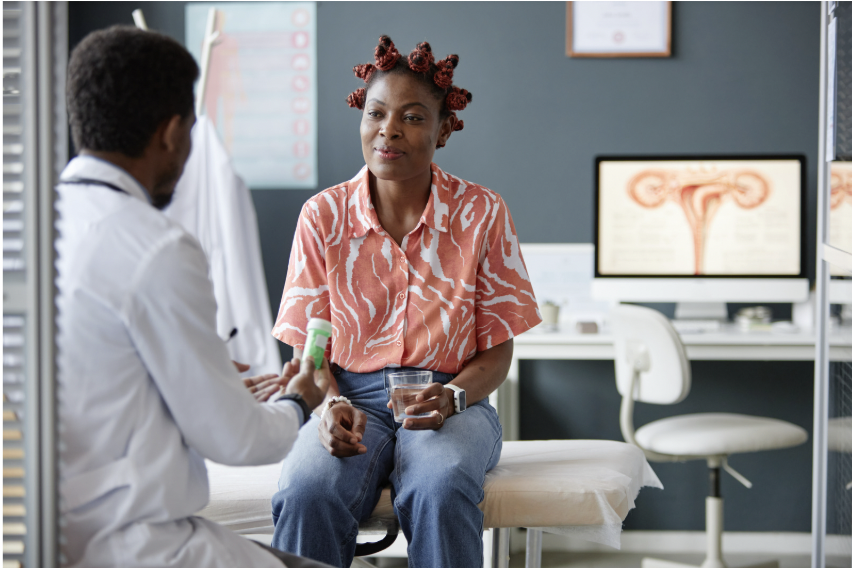
Women deal with misogyny every day. Regardless of your age, life status, or geographical location, there is always a man—or sometimes, unfortunately, a woman with internalised misogyny—who will try to treat you with less respect because you are a woman. When this misogyny originates from the medical field, it becomes even more dangerous, as it leads to women facing unnecessary pain as a result of misdiagnoses, inadequate treatment, and a general disregard for women’s health concerns. Medical misogyny is a concept that should not exist but does and affects women worldwide, including developed nations. Studies indicate that two out of three women have experienced healthcare-related bias and discrimination.
It is even worse when you’re a black woman. There have been several reports of late PCOS and endometriosis diagnoses because women’s pain was dismissed as normal and further tests were not given to determine the cause. Gynaecologists are doctors who specialise in female reproductive health. Male gynaecologists can be controversial since many women feel unsafe with men and often face medical misogyny, leading to distrust in healthcare providers and hesitation to seek necessary medical attention. In today’s edition of Chit-chat with the Gurls, I have a chat about male gynaecologists with three awesome women: Ahi, a Vagina Connoisseur and writer; Doyin, a Nigerian “Feminist Witch” and writer; and Sheila, a broken out of the box/cage Goddess.
Icebreaker
- If your vagina could talk, would it prefer a male or female doctor, and what would its reasoning be?
Ahi: I’m a medical student and I just recently entered the Gynaecologist part of the unit and there are very few women there. They undergo the same medical training as the men and so the way they consult is just like them. I think the system messes it up so much that a female doctor could still have the same bad rhetoric as the men when consulting, and it’s sad. I will say women open up a lot more freely when it is another woman consulting her. She is likely to tell you the things she would be afraid to be judged by with a male doctor.
Doyin: “Get me a female doctor!!!” I don’t want to be violated!
Sheila: If my kitty could speak, she’d definitely want a female gynaecologist. Someone she can be honest with upfront about being 27 and not having had a pap smear, a lump screen, or basically anything when it comes to her feminine body parts. Someone who understands it’s not just about money but what we’ve grown up to prioritise, and unless I’m in present pain, discomfort, or plain sick, seeking their services is not something I think of until there’s news on the telly or a campaign online. My vagina would really like a rundown of how to take care of us with regular medical checkups on a budget.
Do you think any of this can happen? Recently, there was a call to write about a futuristic feminist Earth, and for the life of me, I could not begin to imagine freedom. Not body autonomy, economic freedom, political agency, nothing! I’m still bummed that in my mind, I can’t even leave room to live in a fantastical utopia. ?
Main Questions
- Can you share a memorable experience you’ve had with a male gynaecologist? What made it positive or negative?
Ahi: My first was with this old lady in her private practice down the road from where I lived on the Island, and it was after a pregnancy scare I had with my mum. Umm, I don’t know about the positive or negative of it, lol; it was certainly weird.
Doyin: I met a male gynaecologist this year. The general doctor I had met referred me to him because I had complained of menstrual cramps, which I didn’t think were normal. I got to him and explained everything, and his tone put me off. He dismissed my pain and said it wasn’t “severe”; I wasn’t “special”, and “other women experience the same thing too”.
I’d heard my friends talk about how male doctors could be dismissive, so I mustered up the courage to speak, and then he referred me to the scan. He said, “this is what you want, right? Or do you wish to have a condition so bad?”
I’m not even kidding. ?
I did my research before going to the hospital; pelvic scans alone don’t show you everything, and because I was using my HMO (Health Maintenance Organisation), it restricted my personal request for a scan on the plan. So I just left in annoyance because the scan said I was fine. I didn’t go back to him. I’ll try saving up to do my own tests, like the pelvic-abdominal and transvaginal scans, and then I’ll meet a female gyn.
Sheila: As an adult, I’ve unfortunately not had enough encounters with a gynaecologist, male or female. The experience I’ve had plenty of, if not enough, is psychiatric treatment. From an actual opiate-prescribing female psychiatrist to a male psychologist I couldn’t stand, to a female therapist who preached to me as a remedy, today, I dislike medical practitioners in general.
However, sexual health has also not been a priority, especially when it comes to financial costs. The only time I saw a gynaecologist, I was eighteen and experiencing terrible cramps during my heavy-flow period. The condition got so bad that, twice, I lost consciousness: once in line for dinner and, worse, inside a bathroom. At the hospital, the doctor prescribed medication to alleviate what he called ‘a.m. symptoms’. I never had a physical examination beyond him touching my lower abdomen. What was peculiar was that he asked to introduce my body to contraceptive pills. I’d have to take the pills daily, but my period would finally regulate itself into a steady and, at the very least, bearable flow. I was excited and immediately said yes. Even though I wasn’t a virgin, I also wasn’t having regular sex, and I thought, finally, a ‘solution’. But my mother paused the conversation and left the office to call my dad and confirm/inform him and maybe get permission.
I was more surprised than mad that something hurting inside and up my vagina required his input. Both my folks said yes, but I didn’t renew the pills after that term, which lasted about another month and a half.
- Do you believe there are certain female health issues that male doctors might inherently misunderstand or dismiss? If so, what are some examples?
Ahi: 100%. I have no doubt in my mind. I think language is such an important thing, and when I came back to Nigeria when we studied female hormones, the teacher literally was on some BS about how they are more difficult, essentially making it seem like the fact that the male anatomy was “easier” made it much less hard to study and figure out, and like it gave why are we spending this much time on the women and I’m like, “dude, we carry life, and we don’t even warrant the effort lol, okay.” Another example would be being in the O&G clinic and their husbands giving the presenting complaints instead of her. I don’t know why it rubs me wrong; it just does. The doctor being abjectly homophobic (I just think if you’re homophobic, you shouldn’t be looking at pussy, sha, because nothing about your mind can be delicate enough to understand the organ).
Doyin: Yes. I just mentioned one above. You tell me every woman feels the pain. No, the level of pain differs, and the dismissal is what denies Black women good healthcare. Sometimes, you may not understand my body better than I do. I’m so angry typing this, lol.
So let me tell you my history. I met a male doctor once on this particular issue, and he was straight-up stupid. He suggested getting pregnant or evacuating my womb as a solution. The latter solution – he said he was “just kidding” when I clocked him. Then I met this female doctor who was kind and she listened to me. The first doctor kept interrupting me, smh. The female doctor was the one who referred me to the gynae. She understood me and my symptoms.
Sheila: With a male doctor, it’s easier to fall back and sanitise symptoms, especially if they require actual physical inspection. If the doctor doesn’t consider this, their questioning may be very shallow and thus not invite what is layered under shame and respect.
- Some argue that medical training should override gender considerations in healthcare. To what extent do you think this statement is true in gynaecology?
Ahi: There is such a thing as “first female this” for a reason because niggas didn’t think we were smart enough to study medicine in the first place, and guess what? Patients have a higher survival rate if their surgical attending is a woman. ? I think even the babes in gynaecology mostly see it as a cash cow thing (I can stand to be corrected but the baby-making and incubating industry is a fucking cash cow). Misogyny exists within all of us, and I hope that my experiences with more female gynaecologists will change my perspective. However, the first female Head of Department (HOD) in Obstetrics and Gynaecology (O&G) is a strong advocate for women, particularly in sexual assault cases that are severely underreported here.
Doyin: Medical misogyny strikes again.
Sheila: While this sounds ideal and is how our world currently works, I think it might be subjective. Ultimately, I’ll choose a doctor I want, but then again, how many more have a pool of doctors to choose from? Very few I imagine.
My own intimate experience with male medical practitioners was during a surgery I had to take out my gallbladder. The surgeon was male, as were the anaesthetist and the ICU nurse. I was shocked that I had to be fully naked on the table. No one had prepared me for having a catheter inserted in me or that I’d have to be without panties. The surgeon dismissed my shock and I had a catheter roughly put in me. It was very painful and cost my urethra its tenacity for a while. Had I been given the specifics during pre-op, perhaps my vaginismus might not have been so adverse. During the post-op period, a male nurse changed and fed me. He was mostly cordial, except that I couldn’t tell if his demeanour was professional or only buttering me up so I couldn’t say no when he asked for my number before discharge or when he periodically called and texted weeks after. In a way, I felt very violated. None of the female nurses or doctors called me outside office hours or just to say hello; why did he?
I don’t think I have an answer to the question, because males are in all sections of the medical field, and lewd behaviour is not limited to gynaecologists.
- Have you noticed differences in how male versus female gynaecologists approach patient care or communicate about your body?
Ahi: ?Not specifically, because I haven’t seen a lot of female gynaecologists.
Doyin: The difference is the lived experience, which evokes empathy.
Sheila: I hope to visit a gynaecologist next year and find out what the process is like. Still, I’m very freaked out over having to explain why I’ve waited so long or if I’ll be taken as reckless for not prioritising sexual health beyond sex and menstruation.
I’m also quite petite and very conscious about it because, no matter the gender, at the doctor’s, I’m always informed that my body is not ideal and I need to eat better, and I do try hard (sweet potatoes for breakfast) but when it’s made to seem that I’m trying to stay small, it pisses me off because this is just my body and African women can be petite and still very African.
- How do you feel power dynamics shift (if at all) when discussing intimate health concerns with a male doctor compared to a female one?
Ahi: I saw it physically today. The doctor I was attached to was compassionate in his own Nigerian way, but I could still feel a clenching. The questions asked are deeply intimate compared to the regular social questions you ask. For example, you’re supposed to ask about domestic violence (DV), but many men don’t believe that some of the things she describes are actually DV. So how are you supposed to clerk for it? And 100% yes, women are more likely to speak honestly to another woman about the things that shame them. I just wish a lot of them would be inclined to believe her or even understand, maybe. ?
Doyin: In life, you are forced to deal with mediocre men who can’t be challenged because they are men. You have no choice but to listen or put up with them; it happens like that in the hospital, too. The male doctor suggested having kids as a solution – a male thing to say.
And sometimes, you wish to hide some details from them because you don’t want to be judged. They’re men at the end of the day. You see many of them on twitter lacing their medical advice with misogyny. I don’t want anyone using my health issues to score cheap points on twitter.
Sheila: I think the shift begins way before we walk in for an appointment. We label sexual topics—physically, emotionally, and philosophically—as taboo. We do not speak of it until we have to. Therefore, seeking gynaecological services is either an emergency or a privilege. There is no room in the mind to seek help when one’s period misbehaves or feels different. Just tough it out, or buy a painkiller. We can’t imagine that something labelled as sacred, like our uteruses, deserves a professional’s eye. I imagine some think of it as a crime; what will they tell future spouses? Intimate health isn’t advertised or well taught in schools, so we shouldn’t expect adults to understand their bodies; when they do seek help, they bring all this baggage. Maybe the question should be, should medical practitioners have mandatory classes on how to overcome these barriers? Should they assume they will always be professional?
- How much do you think that the gender of a gynaecologist impacts the healing process or comfort of a victim who has experienced abuse during examinations?
Ahi: I think it impacts a lot. Women are more likely to report to a woman or speak to a woman when they are traumatised.
Doyin: Very much. All explained earlier.
Sheila: For a long time, I thought I was weird for disliking sex sometimes because it’s painful. Yet, from time to time, I still feel randy and seek it out. Reading about vaginismus has helped me feel better about myself so much I can’t imagine what a full physical checkup by a woman would be like: maybe more informative on why I’m wired the way I am. I think gender matters a lot because past lovers haven’t always been accommodating of my pain during penetration or the space and time I need to heal before having sex again. I don’t think I can freely have this conversation with a male gynaecologist; I’d be afraid of his own experience with a woman who isn’t elated at penetration.

- Do you think there are ways male gynaecologists can address the potential discomfort some women might feel during consultations to make the experience better for them?
Ahi: 100%, using the right words and applying all the laws of the Hippocratic oath he should, because medicine is ever-changing because we, of course need to evolve and also with the times and types of women they would be seeing
Doyin: They don’t think they make us uncomfortable. We have to dismantle misogyny first by men actually listening to our concerns instead of letting their egos take precedence.
Sheila: Yes, I think they can first accept that discomfort is very valid rather than explain it away with professionalism. Secondly, they should provide feedback forms, online or onsite, where patients can leave their opinions, suggestions, and complaints anonymously. Third, they can hold regular workshops focused on how to effectively interact with female patients and female medical professionals. The same should be applied by female gynaecologists with male patients.
Creatively, they can have fun graphics/comics that portray what a potential visit might look like. The posters can also describe potential concerns in a light tone. An example would be a poster on how vaginal fluids, scents, and hair are all normal, healthy, and unique to each body. They can then give examples of what unhealthy looks like and suggest a self-check that would prompt either seeking medical services or simple knowledge on the human body. I think male patients would also benefit from the same visuals.
Sign-Off Question
- If you could design the perfect gynaecology visit from scratch—no holds barred—in five sentences max, what would that experience look like, and would the doctor’s gender play any role in your utopian vision?
Ahi: Honestly a woman would be fucking great; I ain’t even gonna lie.
The room should smell like lavender, the walls should provide comfort, and the light should be soft so that I don’t feel like my shame is exposed, along with a calm voice, warm hands, and a speculum.
And for the freaking bed to have sheets and not that paper that can stick to you when anything is on it ?.
Doyin: It is me confidently walking to share my health issues, and she is actively listening to my concerns. Proffer a misogyny-free solution and encourage me to check in often
Sheila: I would walk into a reception area and, while awaiting my appointment, browse through a brochure on the basics of a visit. I hope it’s an all-female-run practice and I don’t have to act coy. I’ll ask all the questions and have a lump check and tips on how to care for my kitty at home. (I don’t know what happens there but I will soon.)


