
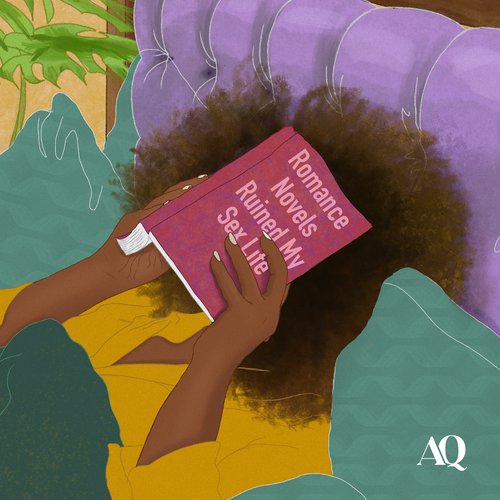
82% of romance readers are women, and most of them discover the genre between the ages of 11-18, which is precisely the period when their ideas about love, sex, and relationships are still forming. I am one of them. At fourteen, while my teachers avoided sex talks and my parents pretended it didn’t exist, romance and erotic novels became my first teachers.
Books from Harlequin and Silhouette were passed around quietly, even though they were strictly prohibited. We handed them to one another in secret, hid them in our lockers, or kept them inside other textbooks. If caught, the books were seized, sometimes torn, and we were punished, but we never stopped. How could we have? The stories were engaging, vivid, and full of experiences no adults were willing to share with us. The sex scenes were described in detail, and that made us imagine what desire and pleasure could feel like.
The novels slowed things down in a way schools and even movies could not. They prepped us and gave us a sense of what to expect and how bodies could respond. They taught me what an orgasm was, why foreplay mattered and that my pleasure should be paramount.
For a generation of young women raised without guidance, these books served as a substitute. They laid the foundation for understanding desire in a world determined to keep us ignorant.
Many other women also turned to these novels for answers. Isabelle grew up in a religious household where discussing sex was taboo. Her mother owned a bookshop, which gave her access to the world of fiction. “Books were my first exposure to sex, even foreplay and all those things,” she tells me. “There was this book; I can’t remember the name, but it was so detailed. Even until now, I have not explored some of the things I read in that book.”
She described reading a Mills & Boon novel that casually mentioned nipples hardening from pleasure. It was a revelation. “I was like, wait, nipples harden because of pleasure? I didn’t know that.”
The novels made Isabelle look at her body differently. They helped her understand her own desires, and she eventually realised she wasn’t straight. The books encouraged her to pay attention to both male and female pleasure, even as she questioned how realistic some portrayals were.
For me, the experience was similar. I learned that sex was way more than penetration. I learned about consent, boundaries, respect in relationships, and what healthy intimacy could look like even before I encountered it in real life.
Isabelle remembers how intense reading these novels in secret was. She felt curiosity and excitement, reading about someone undressing someone else while sitting in a pew at church. “I’d be in class reading, my heart would be pounding and blood would rush to my face,” she added. “I was so hyper-aware.” At the time, she was also watching romantic dramas, which only heightened her fantasy. She admits that she craved the experiences more than she was interested in actual people. “I used to live in another world. You can imagine how delusional I was.”
There was a darker edge to her reading, too. Isabelle noticed that books on Wattpad often failed to show consent. “They were mostly about authoritative, dominant men and submissive women.” These observations made her question herself. “I don’t know if I’m a sub or if it’s just what I fed my brain. I didn’t know what came first — the chicken or the egg.”
Another reader, Fejiro, was the quiet girl who was always buried in a book. She’d bring four to five to school and finish each in two to three days. Her classmates noticed, and they started reading too.
But the influence of those stories created a problem she didn’t anticipate. She did not start dating until she was nineteen, which was mostly because of pressure. When she eventually did date, nothing lived up to what she had read.
“Nothing intrigued me,” she says. “It did not match my taste or standards. I already had a developed idea of what intimacy should feel like.” The novels had given her a blueprint for desire—the “crazy sensations” they described, the feelings that made heroines’ knees weak, and the intensity that seemed to radiate off the page; all of these made real relationships feel underwhelming by comparison.
“Everything I’m seeing in real life feels ordinary. The fantasy was always stronger and you hardly get to see or experience it.”
As an adult, Fejiro came to a realisation: “You see those novels? They are fucking real. They don’t lie; they describe the kinds of feelings everybody wants.” The issue, she believes, was not the books themselves but how difficult it was to find partners capable of meeting those expectations.
For Ify, the impact was different. “Erotic novels gave me a deceptive idea about sex,” she says bluntly. Before she became sexually active, she believed that orgasms would come easily as long as you love the person. The books made it seem effortless and guaranteed. “However, it is not so,” she says. “None of it was practical.”
She read these novels as an escape during boarding school, burying herself in fantasy to avoid bullies and the realities of adolescence. But when she started dating in university, it wasn’t the same. “I realised it does not mirror what I’ve read. Orgasm does not come as easily as they described.” For her, this created misunderstanding about real intimacy and a growing sense that her reality was fundamentally different from what the books had promised.
One thing Isabelle pointed out during our conversation was the lack of physical diversity in desire. Most books she read featured women who all liked the same things, like grabbing their hair, touching their waists, and even tilting their chins. They just focused on a certain type of touch. “For me, I like people sucking my toes, but I never really saw that represented. We need a range that acknowledges our different preferences and physical turn-ons.”
Another troubling issue was the books that romanticised harmful dynamics. She recalls a time-travel erotica where a man forced a woman into sex and later, she fell in love with her attacker. “What the fuck is that? In a novel, an author can write about something toxic and make it look romantic. But some things that translate to real life could be harmful. Let’s not romanticise them in books.”
Still, Isabelle believes romance and erotica can play a positive role in sexual education if done right. “You can’t erase them,” she remarks.
“We need women who have ‘sense’ to write them. More fiction should centre women’s pleasure over men’s and show women touching themselves and discovering what feels good.” She wants diversity in desires, accurate consent representation, and stories that don’t treat red flags as romance.
“Love can be healthy; sex can be both fun and consensual,” she insists. “I am sure there’s a way to balance protecting women while also showing consent, recognising red flags and celebrating romance. That balance can be achieved.”
I believe erotic novels should never have had to be our sex educators. But in the absence of adults who could have taught us and a culture willing to acknowledge that young women have bodies and desires, the books filled that void. They enhanced my vocabulary and demonstrated methods for exploring sex in a consensual manner.
But as Ify said, they rarely show us the reality that good sex is learned through communication and patience. They create standards that real partners struggle to meet and make us believe our bodies would instinctively know what to do.
Still, I do not regret those books, but I wish someone had told me that sex is messier than fiction and that’s okay. I wish someone had told me that fantasy and reality are both beautiful but different. I wish someone had just told me that awkward sex doesn’t mean you are with the wrong person or that orgasm doesn’t come on a cue.
Erotic novels didn’t fail us; society did and then shamed us for seeking that knowledge. They can clutch their pearls about teenage girls reading “dirty books” if they want. While they are busy confiscating novels and avoiding “uncomfortable” conversations, young girls are teaching themselves, and one thing I am sure of is this: We will always find a way to learn.


