

Written by Ylang Ylang
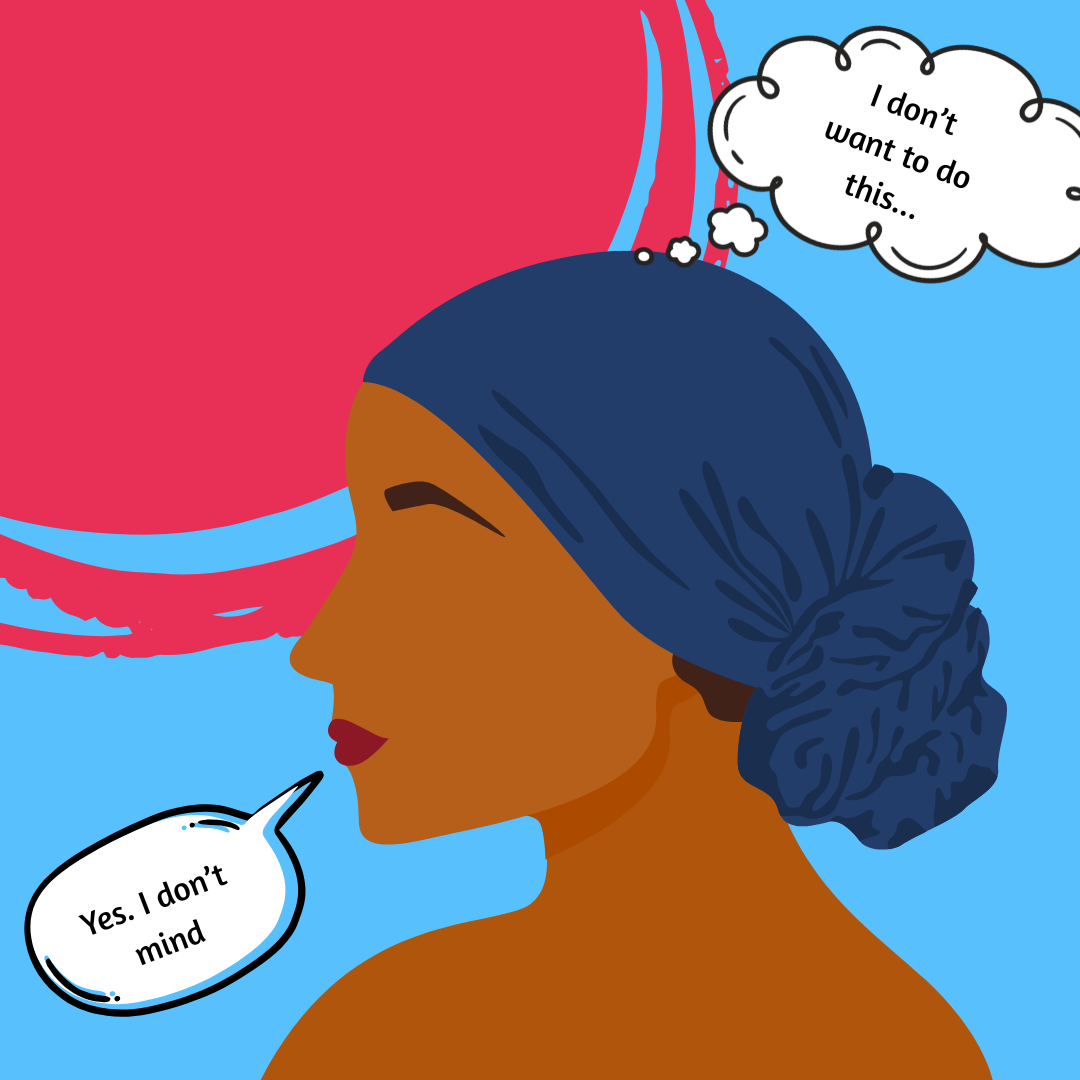
When I met the person I had been sexting with online, whose words of affection had been numbing the voice in my head that tells me I’m unloveable, my stomach dropped. He stood in front of me and I hugged him. I smiled at him too. He returned it with an undiluted fervour. We held hands as I led him into my house, while I desperately sought the arousal that occupied me when we only existed for one another digitally. It was nowhere to be found. We had planned on kissing, and as the moment unfolded, I didn’t want to. But I was afraid of saying no. I was terrified of disappointing someone who had travelled all this way just to see me. I felt obligated to make myself available to him, as he was expecting me to do so, just like we had agreed. So I closed my eyes and kissed him, and I could tell by the way he held me that he was entirely smitten. That only intensified my guilt, and I kept performing to make up for what I couldn’t feel.
If I had told him the truth, knowing him, he would have withdrawn. But at that moment, it wasn’t about him. It was about me and the terrifying resurrection of the people-pleasing I thought I had laid to rest by using the painful wisdom of becoming an adult to learn the confidence to say no in my social and professional life. It never occurred to me that those to whom I said ‘no’ more frequently—mostly women, because they are the ones I am mostly in social and professional contact with—were easier for me to refuse because there was little to no patriarchal friction in our relationships. My hard-won wisdom could only navigate friendships and other casual interpersonal relationships. In the presence of a man, I failed.
****
I first saw the phrase ‘decentre men’ on Twitter. I was a baby feminist, just beginning to deconstruct patriarchal conditioning. I read posts by feminists narrating their experiences with men: how patriarchy conditions women to centre men through desperation for marriage, submission to religious codes that repress women, and willingness to seek male validation even at the expense of safety. I checked myself against it. I learnt and unlearnt. I began to argue and fight with my mom at home because I was rejecting the traditional values of being a good and virtuous woman that she raised me with. Everyone in my friends’ circle started calling me a feminist because I became quick to label men as sexists. I accepted it and wore it proudly.
I had also never dated nor been in any form of intimacy with a man. That made it easy for me to believe I had decentred men, and I had no avenue to test my feminist beliefs against patriarchal friction till the time my online lover came to see me. I was in a room with a man who expected something from me and the ancient, deep conditioning of “keep him safe, make him happy” overrode years of feminist hold in a split second.
I realised I only understood patriarchy intellectually, but I had not discovered where it lived inside me.
Discovering that version of myself who surrendered to what she did not want, especially in a scenario she had always been confident her hard-earned feminism would protect her from, hurt, and I hated her for weeks. I cried until my chest ached.
In this state of mind, something else stood out to me: the difference between fantasising about having sex and having real sexual desire. I had initially thought there was no line between them, that my fantasy was enough proof of desire. But with him in my room, the line became a cliff, and standing just at the edge of it, I was forced to completely deconstruct what I understood boundaries to mean. I found Therapy for Women, and the founders on their Instagram page defined boundaries as how we protect, respect, and value ourselves. Externally, in my social and professional relationships, I could relate to the definition. Someone once told me I inspired her to stand up for herself at the place we both worked. Internally, though, so much more was at stake — self-esteem, self-worth, belief systems, and identity — especially with decades of patriarchal conditioning I hadn’t even begun to unlock as a heterosexual woman. I thought what I achieved externally would make up for the internal. It didn’t. I overrode my boundaries even though I wouldn’t allow anyone else to do it. And it hurt. Deeply. Even after he left and I sent him a voice note firmly cutting off all romantic and sexual possibilities, I wasn’t relieved of the pain.
Now, I am afraid of sex. I am terrified the patriarchal conditioning will always show up and I’m afraid of shrinking. A part of me thinks the solution is a “good partner”, someone who will see my unspoken boundaries even when I am failing to see them myself. But that thought brings no solace. I don’t want a man to rescue me from myself. I want to be the one who sees me.
So every morning, I wake up and choose to forgive myself for what happened with my former online lover. I try to convince myself I’m not a disgraced feminist who couldn’t say no to a man, and most crucially, I relearn sexual agency not just as desire but as the fortitude to hold internal boundaries that can’t be overridden – that desire for sex does not mean compliance.


